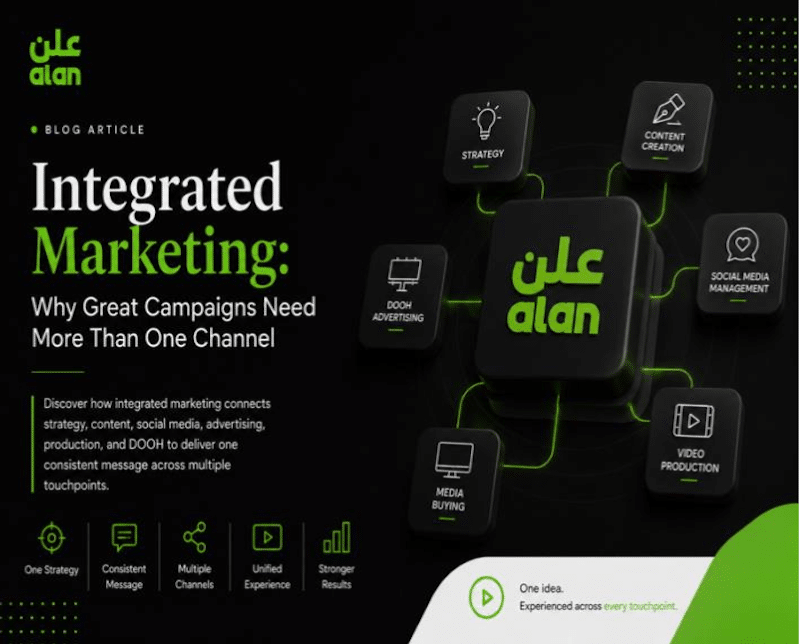
Today, audiences interact with brands across multiple touchpoints. They might discover a brand through a (DOOH Advertising) screen, see its content later on social media, encounter a digital ad, and eventually visit its website.
This is why effective marketing is rarely about using one channel alone. (Integrated Marketing) brings different marketing activities together to create one connected and consistent brand experience.
What Is Integrated Marketing?
(Integrated Marketing) is an approach that connects different marketing channels under one strategy, message, and creative direction.
Instead of treating social media, advertising, content, production, and outdoor campaigns as separate activities, an integrated (Marketing Campaign) ensures they work together toward the same objective.
The goal is not simply to be present everywhere. It is to make every channel contribute to the same story.
Why Is Consistency Important?
Imagine seeing a brand on a digital billboard and later finding it on social media, but the visuals, tone, and message feel completely different.
Even if both advertisements are individually strong, the overall brand experience can feel disconnected.
A strong (Digital Marketing Strategy) creates consistency across different touchpoints. Visual identity, messaging, content, and campaign objectives should support one another while still adapting to the format of each platform.
Consistency does not mean posting exactly the same content everywhere. It means making sure every piece of communication feels like it comes from the same brand.
How Can Different Marketing Channels Work Together?
Each marketing channel has a different role.
A DOOH campaign can create large-scale awareness in public spaces. Social media can continue the conversation and encourage engagement. Content creation can communicate the idea in different formats, while media buying can help distribute the campaign to relevant audiences.
This is the idea behind (Multi-Channel Marketing): using the strengths of different channels while keeping them connected to one larger strategy.
For example, a brand launching a new product could introduce the campaign through outdoor digital screens, continue its story through social content and videos, and support it with targeted digital advertising.
The audience experiences different parts of the campaign, but the message remains connected.
Strategy Comes Before Channels
One common mistake is choosing marketing channels before defining what the campaign needs to achieve.
A successful (Marketing Campaign) should begin with clear objectives and an understanding of the target audience. Only then should brands decide which channels, content formats, and media placements can best support those objectives.
This is also where working with a (Marketing Agency) that can connect strategy, creative, production, and media becomes valuable. Instead of managing each part in isolation, the campaign can be developed as one complete experience from the beginning.
One Idea, Multiple Touchpoints
The strongest integrated campaigns are not necessarily the ones that appear on the most platforms. They are the ones where every platform has a clear purpose.
When strategy, creative content, media, social platforms, production, and outdoor advertising work together, a campaign becomes more than a collection of separate advertisements.
It becomes one idea experienced across multiple touchpoints.